How nighttime LST works and why it matters
Nighttime Land Surface Temperature measurements are possible because satellites capture thermal infrared radiation that is naturally emitted by the Earth’s surface. Unlike optical imagery, which depends on reflected sunlight, thermal sensors measure the energy radiated by objects themselves as a function of their temperature.
All surfaces — whether water, soil, vegetation, or built infrastructure — continuously emit thermal radiation, both during the day and at night. This means that even in complete darkness, satellites can detect and quantify surface temperature based on the intensity of this emitted energy.
This is fundamentally different from optical data:
- Thermal infrared (LST): Measures emitted radiation → works day and night
- VNIR / RGB imagery: Measures reflected sunlight → requires illumination → not available at night
Because there is no sunlight at night, traditional optical bands (VNIR/RGB) cannot capture usable imagery. While thermal imagery can be captured at night, this absence of visible reference features can make georeferencing and image interpretation more challenging, as there are fewer familiar visual landmarks compared to daytime scenes.
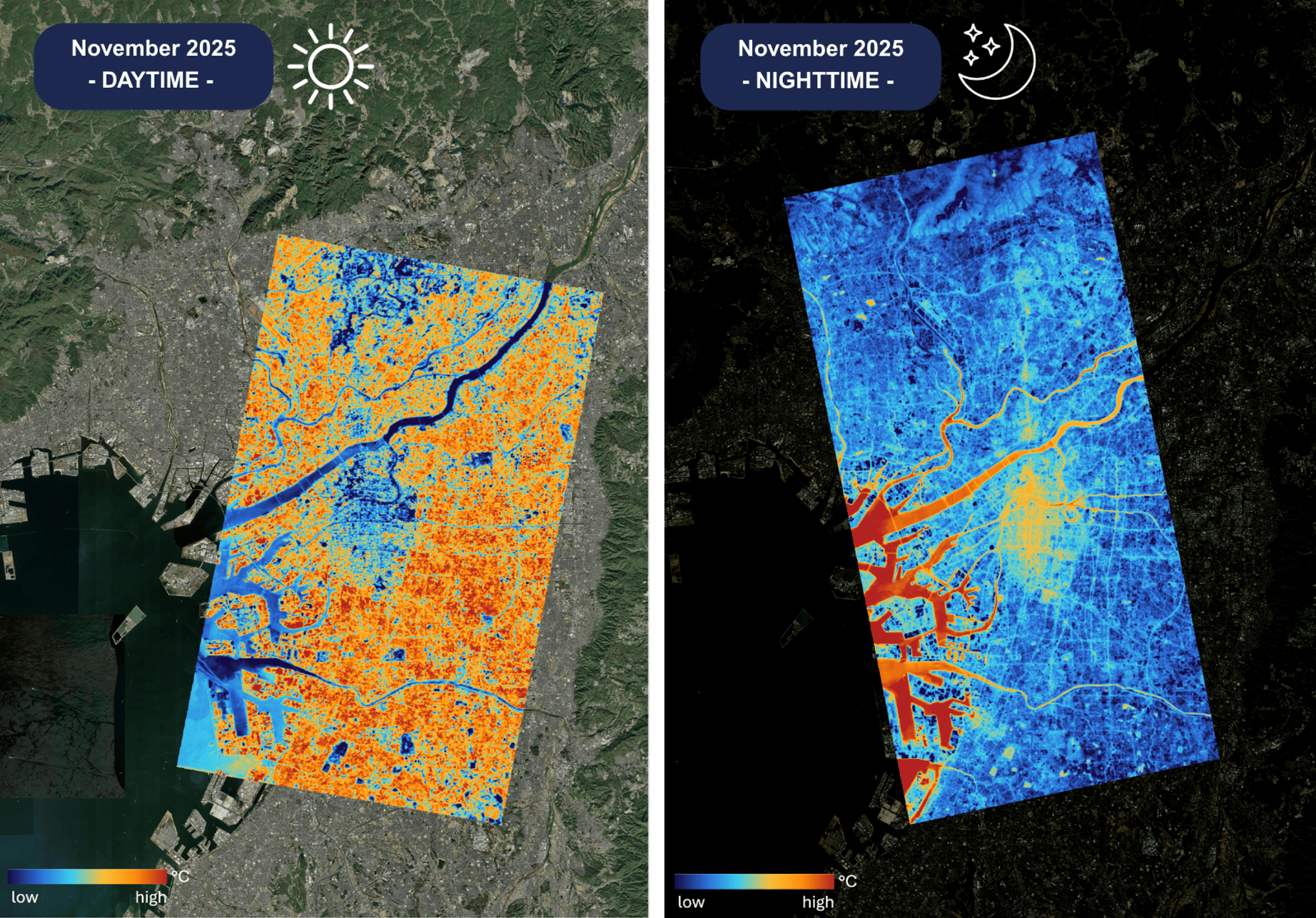
However, this same absence of solar illumination is precisely what gives nighttime LST its unique value. Two wider applications emerge here:
-
Without the influence of solar heating at night, day vs night comparisons reveal how heat is stored and released by surfaces, providing a clearer and more actionable view of thermal behavior.
Use case examples:
-
Urban heat monitoring
Nighttime data reveals how cities retain heat, highlighting persistent hotspots that impact public health and energy demand. -
Infrastructure stress
Day-night behavior provides insight into the material used in infrastructure, such as transportation tracks or energy infrastructure. Here, weak spots requiring maintenance can be identified, using imagery that covers large areas at a repeated frequency without the need for in-situ measurements.
-
-
At night, the contrast between active and inactive systems becomes more pronounced. True thermal signals emerge, making anomalies, activity, and infrastructure dynamics significantly easier to detect. This makes nighttime LST especially powerful for operational monitoring and situational awareness.
Use case examples:
-
Maritime awareness
Thermal contrast between water and vessels is enhanced at night, improving detection of ships, tracking of maritime activity, and identification of anomalous behavior — even in low-visibility conditions. -
Critical industrial monitoring
Facilities such as power plants, including nuclear sites, exhibit distinct thermal signatures linked to operations. Nighttime observations make it easier to detect changes in activity, monitor cooling processes, and identify potential anomalies. -
Defense and security applications
The absence of solar interference enhances the detection of human activity, equipment usage, and infrastructure operations, providing a reliable layer of intelligence for surveillance and reconnaissance.
-
By isolating heat retention rather than solar input, nighttime LST delivers high-contrast, low-noise, and operationally relevant thermal intelligence, making it a critical asset for monitoring, security, and decision-making in complex environments.
